
The Authority Gap: Why Newer Shops are Outranking Your 10-Year-Old Profile
The Authority Gap: Why Newer Shops are Outranking Your 10-Year-Old Profile
For over a decade, you have built your business on a foundation of quality service, community trust, and a solid reputation. You were one of the first in your city to claim your Google Business Profile (formerly GMB). You have hundreds of reviews, a decade of history, and a physical location that hasn’t moved in years. Yet, when you search for your primary services today, you see a “pop-up” shop – a competitor who opened their doors six months ago – sitting comfortably at the #1 spot in the Map Pack. Your phone is ringing less, your leads are drying up, and you are left wondering: how is this possible?
Welcome to the Authority Gap. This phenomenon is becoming the new reality for established businesses across the United States. Whether you are a plumber in Phoenix or a personal injury lawyer in Chicago, the “seniority” you once relied on is being dismantled by a new generation of google business profile seo strategies. The hard truth is that Google’s algorithm no longer views age as a primary shield against competition. In fact, in many cases, your profile’s age might actually be working against you due to “legacy drag.”
Recent data from industry experts like Joy Hawkins suggests that while total impressions for established profiles may remain stable, call volumes are dropping – sometimes by as much as 48% year-over-year. This indicates that while you are still being “seen,” you are no longer being “chosen.” The Authority Gap is the space between your perceived reputation and the algorithmic relevance Google now prioritizes. To close this gap, we must first understand the shift from static prominence to dynamic engagement.
II. The Three Pillars of Local Ranking: Relevance, Proximity, and Prominence
To understand why newer shops are winning, we must look at how Google calculates local rankings. Historically, Google has balanced three core pillars: Relevance, Proximity, and Prominence. However, the weight assigned to these pillars has shifted dramatically in the lead-up to 2026.
- Relevance: How well a local business profile matches what someone is searching for. This is no longer just about your business category; it is about the depth of your service menu and the keywords found within your reviews.
- Proximity: How far the searcher is from the business location. Google has begun “slicing the map” thinner than ever before, often prioritizing a nearby shop over a more “prominent” one blocks away.
- Prominence: This is where the Authority Gap lives. Prominence used to be defined by how well-known a business was offline – think landmarks or famous local brands. Today, Google uses Engagement as a proxy for prominence.
If a new shop generates 20 reviews in a month while you generate two, Google’s algorithm interprets that “Review Velocity” as a signal of current popularity. To the algorithm, the new shop is more “prominent” in the present moment than the shop with 500 reviews from 2019. This shift is one of the 4 Real Reasons Your Competitors Own the Local 3-Pack.
Newer businesses are often more agile. They are unburdened by old SEO habits and are quick to adopt a google maps ranking service that focuses on these modern engagement signals rather than just building citations and waiting for the phone to ring.
III. Why Age is No Longer a Shield
Many business owners fall into the “Legacy Trap.” They believe that because they have been at the same address for 20 years, they have an unbreakable bond with the local search algorithm. This was largely true until the August 2025 Spam Update and the subsequent refinements that targeted “stale” profiles.
Established businesses often “set and forget” their profiles. They might have a primary category selected, but they haven’t touched their attributes, updated their service descriptions, or posted a GBP update in years. Meanwhile, the new competitor is utilizing every available pixel of the google business profile optimization toolkit. They are adding “Identifies as veteran-owned,” “Wheelchair accessible,” and detailed “Service Area” specifications that provide Google with more data points to match with specific user queries.
Furthermore, the August 2025 update significantly penalized business names that were stuffed with keywords – a tactic many old-school businesses used to get away with. If your profile name is “Best Plumbing & Drain Cleaning Phoenix” but your legal name is just “Smith & Sons,” you are now a target for demotion. Newer shops, entering the market with a fresh understanding of google maps seo, are naming their businesses strategically or focusing on “Clean” SEO that Google trusts more deeply.
The “Authority Gap” widens when an old business relies on its history while a new business relies on its activity. In the eyes of a 2026 algorithm, activity beats history every single time. If you aren’t actively proving your relevance daily, you are essentially invisible to the modern gmb ranking service models.
IV. The Engagement Shift: The 2026 Popularity Signals Update
The **March 2026 Algorithm Update** was a watershed moment for local search. It codified what many SEOs had suspected: Google now prioritizes real-time engagement signals over static signals. This update introduced the “Popularity Signals” metric, which looks at the frequency of user interactions with a profile.
Consider two businesses:
Business A: 15 years old, 600 reviews, 4.8-star rating. It gets 1 review every two months.
Business B: 1 year old, 120 reviews, 4.6-star rating. It gets 15 reviews every month.
In the old world, Business A wins. In the 2026 landscape, Business B often takes the top spot. Why? Because Business B has higher **Review Velocity** and **Review Recency**. Google views the steady stream of new feedback as proof that the business is currently operational, currently popular, and currently providing a service that people want to talk about. This is a core reason why you must 3 New Signals That Force a Fast 3-Pack Ranking in 2026.
Engagement isn’t just about reviews, though. It includes:
- Click-to-Call Frequency: How many users are actually hitting the call button?
- Direction Requests: Are people actually navigating to your physical location?
- Photo Views: Is the business uploading fresh, high-quality photos that users spend time looking at?
- Booking/Messaging: Are you utilizing the built-in “Request a Quote” features?
If your competitor is using local seo services to drive these specific interactions, they are effectively “hacking” the prominence pillar. They are creating an artificial sense of popularity that Google’s AI interprets as genuine authority. To compete, you must move beyond the “we’ve always been here” mindset and start generating modern engagement.
V. Proximity vs. Relevance Modeling
One of the most frustrating aspects of the Authority Gap is seeing a competitor outrank you simply because they are closer to the searcher – even if they are a significantly “worse” business by objective standards. Google is “slicing the map” thinner, creating hyperlocal bubbles of visibility.
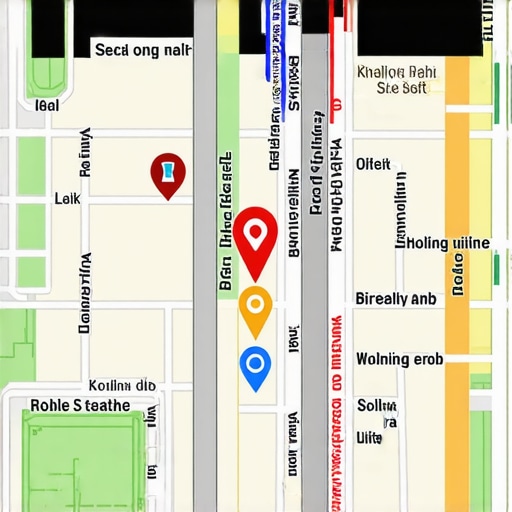
However, there is a way to overcome the “Distance Factor.” Google’s algorithm allows **Relevance** to override **Proximity** if the relevance score is high enough. This means that if a searcher is standing right next to a new shop, but your 10-year-old profile is perfectly optimized for the specific long-tail keyword they used, you can still win the “Map Pack” spot. This is where local seo software becomes essential. You need to see exactly where your rankings drop off – is it two blocks away or two miles? Tracking this “ranking radius” allows you to identify where you are losing the battle to newer entrants.
Established businesses often suffer from “Category Dilution.” They try to be everything to everyone. A newer shop might focus exclusively on “Water Heater Repair” as their primary category and optimize every post and photo around that niche. When a user searches for that specific term, the new shop’s hyper-relevance beats the old shop’s general prominence. You can see this reflected in 3 Map Analytics Metrics That Prove Why You’re Losing Local Clicks.
To close the gap here, you need to audit your categories. Are you using the most specific primary category possible? Are your secondary categories supporting your main goal or just adding noise? Use a google maps rank tracker to test how changing your categories impacts your visibility across different parts of the city.
VI. The “Zero-Click” Problem & Call Attrition
Perhaps the most dangerous part of the Authority Gap is when your google business profile ranking looks “fine,” but your actual leads are down. You might still be in the Top 3, but the new guy at #2 is getting all the calls. This is the “Zero-Click” problem, where users get all the information they need from the search results page without ever visiting your website.
Newer competitors are winning the “click” by leveraging Review Keywords and Justifications. Have you ever seen a little bolded snippet under a Google Maps listing that says *”Their website mentions ’emergency pipe repair'”* or *”A reviewer mentioned ‘best divorce lawyer in town'”*? Those are justifications, and they are massive conversion drivers.
Newer shops are often coached by a local seo agency to ask customers for specific keywords in their reviews. When a customer writes, “They are the best **emergency plumber in Phoenix**,” that review becomes a ranking signal that triggers a justification. If your 10-year-old profile has 500 reviews that just say “Great job!” or “Good service,” you are missing out on the semantic data Google needs to justify putting you at the top. This is exactly How Specific Review Keywords Triggered a Quick GBP Boost for Our Clients.
Furthermore, newer profiles are often more diligent about their **Service Menus**. Google now allows for highly detailed, price-transparent service lists. If a user can see exactly what you charge and what you offer directly in the Map Pack, they are much more likely to click the “Call” button. If your profile is a “Legacy” profile with no services listed, you are effectively a ghost in the machine.
VII. Conclusion & Action Plan: Closing the Authority Gap
The Authority Gap is not a death sentence for established businesses; it is a wake-up call. Your 10 years of history are a valuable asset, but only if they are paired with modern, aggressive google maps seo tactics. Authority in 2026 is not something you *have*; it is something you *maintain*.
To reclaim your spot at the top of the Map Pack, you must:
- Audit Your Technical Presence: Use a google business profile audit tool to identify missing attributes, stale posts, and category mismatches.
- Ignite Review Velocity: Don’t settle for your existing review count. Implement a system to generate new, keyword-rich reviews every single week.
- Maximize Engagement: Treat your GBP like a social media profile. Post updates, add new photos weekly, and respond to every question and review within 24 hours.
- Optimize for Relevance: Narrow your focus. Don’t just be a “Lawyer.” Be the “Top-Rated Car Accident Attorney” through specific service descriptions and justifications.
The “newbie” threat is real, but they lack the depth of experience you possess. By applying modern google business profile optimization to your established reputation, you can create an “Unstoppable Profile” that dominates the local market for the next decade. For more specific strategies, check out Staying Visible: 5 Vital Google Business Profile Tips for 2026.
Don’t let a six-month-old shop steal the leads you’ve worked ten years to earn. Close the Authority Gap today.